Topics / Stage operations
Operate the stage Turn a promising setup into a repeatable production state—with timing checks, restores, and a tested fallback.
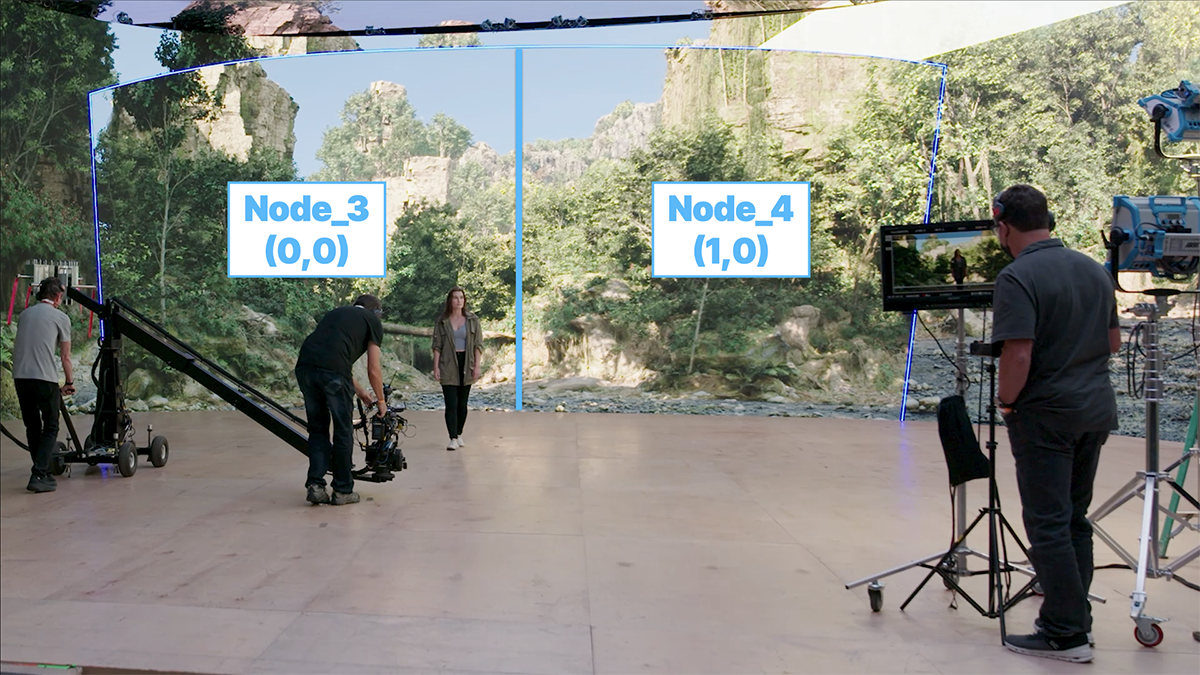
Epic captions this image as multiple nodes used for an inner-frustum split on an ICVFX shoot. Epic Games / Unreal Engine Documentation · Publication permission pending owner review. View full size Start with these questions Epic Games / Unreal Engine Documentation · source visual
Stage operations / Guide
A practical introduction to nDisplay, the camera frustum, and the point where a screen becomes part of a calibrated system.
Epic Games / Unreal Engine Documentation · source visual
Stage operations / Guide
Matching numbers are not proof that the whole image pipeline is synchronized. Test timing and delay as separate questions.
Epic Games / Unreal Engine Documentation · source visual
Stage operations / Guide
Understand the controller/listener relationship, then build a small readiness routine around the actual production configuration.
Epic Games / Unreal Engine Documentation · source visual
Stage operations / Guide
A restart is successful only when the team can prove the recovered scene, control state, and stage image match the named baseline.
Go deeper Epic Games / Unreal Engine Documentation · source visual
Stage operations / Guide
Map the usable volume, occlusions, and failure boundaries with the real camera configuration—not only the tracker’s central sweet spot.
Stage operations / Guide
The relevant question is not whether a background looks detailed; it is how its geometry behaves when camera position, focus, foreground, and occlusion change.
Stage operations / Archive record
ILM's own pages date preliminary StageCraft testing to 2018 and the first full-scale volume to The Mandalorian's November 2019 debut.
Stage operations / Archive record
ROE Visual's own product pages describe pixel pitch, refresh rate, and finish choices made for what a camera records, not a viewer.
Stage operations / Archive record
A September 2023 Sony press release positions Crystal LED VERONA as purpose-built for ICVFX, distinct from Crystal LED's general display line.