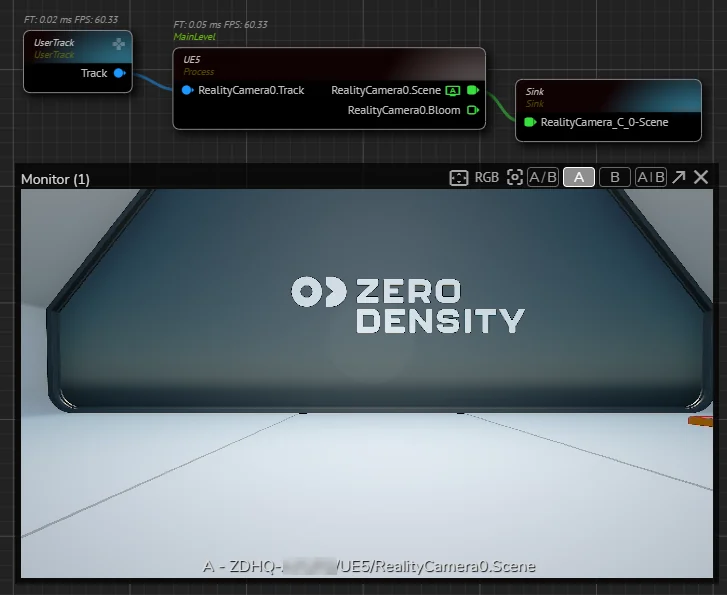
The stage
Zero Density's flagship product, Reality 5, is described on the company's own site, reached today at zerodensity.io after the vendor's former zerodensity.tv address redirected there, as a platform for 'augmented reality, virtual studios, XR, on-air graphics, and videowall production.' The company homepage names the broadcasters it says it serves: ABC, CBS, Charter Communications, FOX, The Weather Channel and Univision. Those are named customers in the vendor's own copy, not an independently verified list, and both pages describe the product as it exists today, so this entry treats them as living documents current as of 16 September 2026.
What the documents establish
The vendor's own language places Reality's primary market in broadcast: sports, news, elections, corporate, education, live events, entertainment and esports are the sectors named on the homepage, and 'virtual production and broadcast graphics' is the company's self-description. Reality 5's compositing is described as 'node-based compositing, low-latency video I/O, versatile camera tracking support, and image-based keying.' A separate NODOS toolset feature is labelled 'XR / LED Volumes Processing,' the only place either page connects Reality to LED-volume workflows, and neither page elaborates that feature with the detail it gives broadcast graphics. A vendor naming a feature is not the same as documenting how it is used on a film or television ICVFX stage.
The department view
A broadcast graphics operator or virtual-studio technical director is the person most likely to run Reality day to day, working from a control room rather than a stage floor, compositing live talent into a rendered set for a news or sports broadcast. That is a different role, with a different tolerance for latency and a different relationship to camera tracking, than an ICVFX operator managing a genlocked LED wall for a film unit. Where Reality's NODOS toolset does touch LED volumes, the documentation available does not describe who on a film crew would operate it or how it hands off to a DP and gaffer, the detail expected before treating a broadcast tool as an ICVFX one.
What to check before you build
This is an editorial checklist. Verify whether a specific Reality deployment is running the broadcast graphics pipeline or the NODOS XR/LED toolset, since the vendor's public pages describe them at very different levels of detail. Do not treat the six named broadcasters as evidence of film or television virtual-production adoption; they are broadcast customers as the vendor states them. Confirm current product naming and URLs directly with Zero Density, since the company's domain moved from zerodensity.tv to zerodensity.io during the period this entry was prepared.
- Is this deployment broadcast graphics or the NODOS XR/LED Volumes toolset, and does the vendor document both equally?
- Which named broadcast customers, if any, resemble the production's own genlock and latency requirements?
- Who operates the system on set, and what is their reporting line to the DP or technical director?
Reality's own materials describe a broadcast-graphics company with an LED-volume feature, not a film ICVFX platform with a broadcast side. Keeping that order straight matters more than the marketing page's list of sectors suggests.
Sources & reading trail
States Reality 5's target markets (AR, virtual studios, XR, on-air graphics, videowall production) and named broadcast customers.
Source published: Not established · Retrieved: 16 September 2026
States Zero Density's self-description as a virtual production and broadcast graphics company and lists its named industries.
Source published: Not established · Retrieved: 16 September 2026
Vendor documentation, standards and reports establish the entry; the department view is Stagecraft Atlas editorial analysis. This retrospective draft does not imply the site published on the event date.