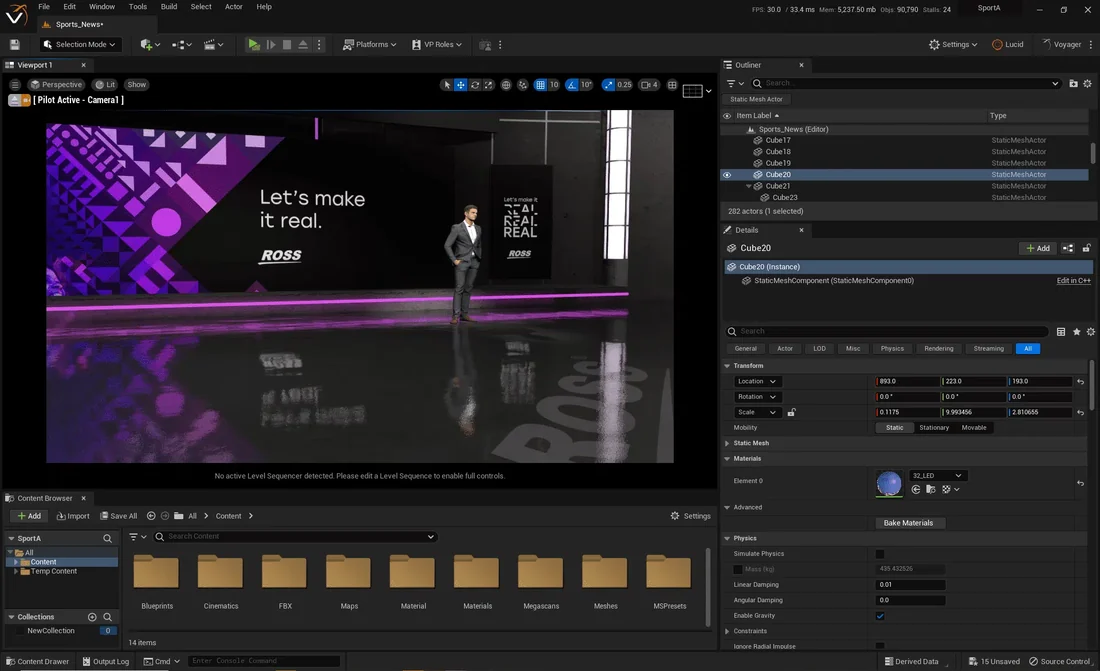
The stage
Ross Video positions itself, on its own site as retrieved 16 September 2026, as 'Powering the world's greatest live productions,' with a product category called 'Graphics & Virtual' that includes Voyager, Lucid and Raiden. The dedicated Voyager page describes the product as bringing 'photorealistic virtual environments to live production' and states directly that 'Voyager, the Unreal Engine based rendering platform, integrates with MOS and XR LED workflows, Lucid, and Ross automation for efficient virtual live production.' Both pages are living documents, not a dated release announcement.
What the documents establish
The product page's own language names 'XR LED workflows' as an integration point, so a connection between Voyager and LED-volume work is the vendor's own claim, not this site's inference, though the page documents that connection in a single line rather than with the depth it gives broadcast graphics features. Those features include 'real-time dynamic shaders' delivering 'dynamic shadows, live lighting, light blooms and real-time reflections for use in AR and virtual studio environments,' and integration with Ross's own XPression, OverDrive, Ross Robotics, Raiden and PIERO tools, plus Lucid Studio for centralizing control of 'Voyager engines, tracking systems and virtual scenes.' Ross Video's own homepage frames its core industries as broadcast news, sports, live events and corporate work; film and television production are not named among the homepage's listed industries.
The department view
Voyager's documented operator is a broadcast graphics or virtual-studio technical role, working inside a live-production control chain built around MOS newsroom integration and Ross's own automation stack, a different working rhythm than an ICVFX volume's on-set brain bar. Where Voyager's page names XR LED workflow integration, it does not describe a department handoff to a DP, gaffer or on-set VFX supervisor the way this site expects of a true ICVFX tool; the documented handoffs are to Ross's own broadcast product family instead. A production borrowing Voyager for LED-volume work should expect to build that handoff itself, since the vendor's page does not document one.
What to check before you build
This is an editorial checklist. Confirm whether 'XR LED workflows' as named on the Voyager page refers to the same wall-processing chain a specific volume runs, since the term is not elaborated with hardware names. Verify Voyager's Unreal Engine version and whether it tracks Epic's own release cadence, since the page names Unreal Engine support without specifying a version. Check whether Ross's own automation stack, OverDrive and Lucid Studio, is a requirement for LED-volume use or an optional broadcast-only layer.
- Does 'XR LED workflows' on the Voyager page match the wall-processing hardware this build already uses?
- Which Unreal Engine version does Voyager currently run, and how does Ross Video track engine updates?
- Is Ross's own automation stack required for LED-volume use, or only for the broadcast workflow the page documents in depth?
Voyager's own documentation is broadcast-first with a named but thin LED-volume connection. That is a real, vendor-stated link, not a blurred one, but it is thinner than the rest of the page's detail.
Sources & reading trail
States what Voyager does, its Unreal Engine basis, its named XR/LED workflow integration, and its broadcast feature set.
Source published: Not established · Retrieved: 16 September 2026
States Ross Video's self-description and named industries, none of which name film/TV production directly.
Source published: Not established · Retrieved: 16 September 2026
Vendor documentation, standards and reports establish the entry; the department view is Stagecraft Atlas editorial analysis. This retrospective draft does not imply the site published on the event date.