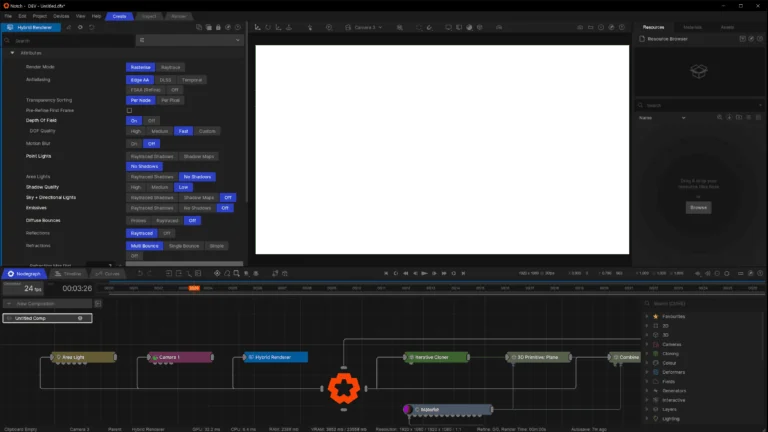
The stage
Notch does not build a stage; it feeds one. Notch's own site, retrieved 16 September 2026 from the company's product page, describes the software as a '3D motion design tool that brings your imagination to life in real time,' built to render 'motion design and visual effects in real-time' on a GPU. The vendor names six sectors it targets: concerts and performing arts, motion design and animation, fixed and interactive experiences, corporate events, film, TV and streaming, and virtual production, where it names LED stages, green screen and tracked-camera work. This is a living description, not a dated release, and reflects Notch's own framing of where the tool sits, not an independent survey of adoption.
What the documents establish
Notch's own materials, not a third-party benchmark, state that the tool handles procedural geometry, textures and fields 'without baking,' and particle simulations and volumetrics at 'hundreds of millions of points in real-time.' That is a generative-content claim, distinct from any claim about camera tracking or ICVFX rendering, which Notch's site does not make. The Notch manual, also a living document, corroborates the product's shape: a section on working with media servers documents integration with disguise, Resolume, Hippotizer, LightAct, Screenberry and 7thSense Delta, and camera nodes, including a hardware tracking camera, that consume external tracking data rather than generate it. Neither document describes the gameplay or physics tooling a game engine such as Unreal ships with; the manual is organized around compositing, post-effects and node-based generation instead.
The department view
On the stage, Notch content usually arrives through the media server or render node driving the LED wall's pixel-mapped output, not through the engine handling camera-locked background plates. That places Notch with a content artist near the brain bar rather than the virtual art department building tracked environments. The trade-off implied: Notch suits abstract, generative content, such as waveforms or data visualization, where exact parallax against a tracked lens is not the point, while a tracked ICVFX background plate still depends on a separate tracking and rendering pipeline that Notch plugs into rather than replaces.
What to check before you build
This is an editorial checklist. Confirm which layer of the volume a given Notch instance drives, a fixed media-server feed or a tracked ICVFX background, since the vendor's own materials only document the first as core. Confirm which media-server or engine integration a production's disguise, Resolume or Brompton chain supports, since Notch's compatibility list is itself a living document. Confirm who owns the tracking feed: Notch's camera nodes consume tracking data but the manual does not describe Notch generating it.
- Is the content generative, or does it require frame-accurate camera parallax against a tracked lens?
- Which media server or processor is Notch feeding, and is that integration current in the vendor's documentation?
- Who on the crew owns the tracking feed that Notch's camera nodes will consume?
None of this makes Notch a lesser tool on the stage; it makes it a different layer. Reading a generative-content page as a tracking or rendering claim is the kind of category error a department note exists to prevent.
Sources & reading trail
States what Notch is built for, its target sectors, and its virtual-production use case (LED stages, green screen, tracked camera).
Source published: Not established · Retrieved: 16 September 2026
Documents Notch's media-server integrations and camera nodes that consume, rather than generate, tracking data.
Source published: Not established · Retrieved: 16 September 2026
Vendor documentation, standards and reports establish the entry; the department view is Stagecraft Atlas editorial analysis. This retrospective draft does not imply the site published on the event date.