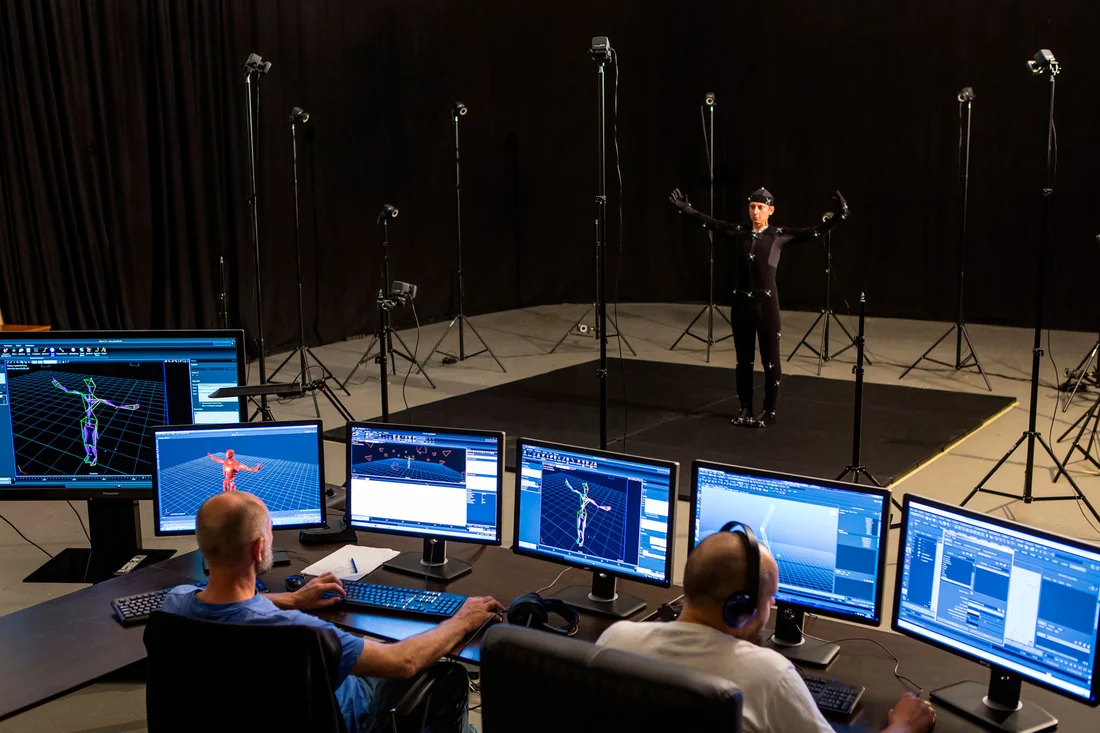
The stage
Vicon's own homepage, as retrieved 16 September 2026, calls the company 'a global leader in motion capture technology for over 40 years,' offering 'optical and markerless motion capture, inertial tracking, and VR solutions' across life sciences, entertainment and engineering. Camera tracking for virtual production sits inside that business as a named application rather than a standalone division: the company's own virtual-production application page describes combining Vicon's optical motion-capture hardware with its Shogun software to track both performer and camera in one volume. Both pages describe a current offering rather than a dated product launch.
What the documents establish
The virtual-production page states that Vicon's 'motion capture systems track performer movements and camera positions simultaneously, allowing real-time rendering of digital characters, environments, or effects directly onto LED screens,' and frames the workflow as in-camera VFX integration in which 'motion tracking data drives camera movement and parallax effects, synchronizing virtual camera movements with physical camera rigs.' The page also claims that solving 'VFX challenges on set' this way 'reduces post-production workload, compressing overall project schedules,' the vendor's own framing rather than an independently measured comparison. Separately, the hardware page lists Vicon's core camera lines, Valkyrie, Vanguard and Vero, and its Blue Trident inertial sensor, none marketed there as dedicated tracking-only products; they are the same cameras sold for motion capture generally.
The department view
A production using Vicon for combined performer-and-camera tracking is, per the vendor's own description, most likely already running Vicon hardware for performance capture and extending that same optical volume to include the camera, placing the work with a motion-capture supervisor and the virtual production or previs team rather than with a tracking specialist brought in solely for camera work. That is a different starting point than a dedicated camera-tracking vendor: a production without an existing mocap need may find Vicon's tracking capability arriving bundled with mocap infrastructure it does not otherwise require, a cost and complexity trade-off the vendor's application page does not address directly.
What to check before you build
This is an editorial checklist. Confirm whether a production actually needs combined performer-and-camera tracking or only camera tracking, since Vicon's documented strength and installed base is motion capture first. Ask Vicon directly what a camera-tracking-only deployment costs and requires relative to a full mocap-plus-camera setup, since the application page describes the combined workflow, not a camera-only configuration. Verify Shogun software version compatibility with the render engine and LED processor in use, since the page names the workflow without specifying supported versions.
- Does this build need combined performer-and-camera tracking, or only camera tracking, and does that change which vendor fits best?
- What does a camera-tracking-only Vicon deployment cost and require, compared with the full mocap-plus-camera workflow the page describes?
- Which Shogun software version is required, and is it confirmed compatible with the render engine and LED processor already in use?
Vicon's own materials are candid that camera tracking for virtual production rides on top of a much older motion-capture business. That is useful context for a production deciding whether it needs Vicon's full capture ecosystem or a lighter, dedicated tracking system instead.
Sources & reading trail
States how Vicon combines optical motion-capture hardware with Shogun software to track performer and camera together for ICVFX.
Source published: Not established · Retrieved: 16 September 2026
States Vicon's core business as motion capture for over 40 years, the older business camera tracking builds on.
Source published: Not established · Retrieved: 16 September 2026
Vendor documentation, standards and reports establish the entry; the department view is Stagecraft Atlas editorial analysis. This retrospective draft does not imply the site published on the event date.