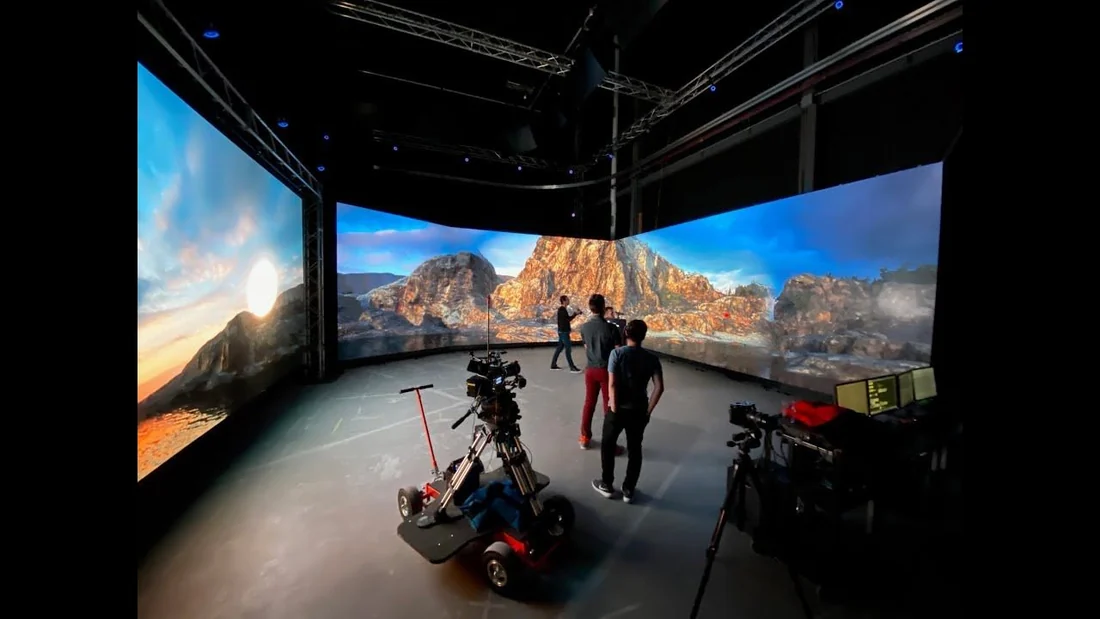
The stage
The Entertainment Technology Center at the University of Southern California, retrieved 16 September 2026, describes itself on its site as "a USC School of Cinematic Arts research center and industry convenor exploring how emerging technologies change the way entertainment is created, distributed, archived, and experienced," naming "media, AI, and production workflows" as a focus area. Under that mandate sits a project ETC's own site lists as AI & Emergent Media, researching "production workflows that combine physical stages, real-time rendering, LED volumes, and adaptive creative pipelines." This is a living program: the page names case studies from an early short through a 2024 production called Europa, and ETC's publications index lists a dedicated 2025 title, "EUROPA: An Odyssey into On-Set Virtual Production."
What the documents establish
ETC's materials establish the scope of one university-affiliated center's work, not an industry census. The project page states Europa's goals included "deep metadata/ontology workflows," "cross-functional teamwork with Sony," remote-collaboration testing, streamlining the virtual art department, and "optimizing anamorphic lens distortion and camera/lens metadata usage on an LED volume." Those are ETC's own stated goals for one exercise, not verified findings about the wider industry. The index separately lists a multi-chapter series, "Fathead: Virtual Production & Beyond," running 2023 into 2024, alongside a 2021 short, "Ripple Effect." Together the pages show a center running its own exercises and publishing what it learned, distinct from a trade outlet reporting on other builds or a vendor describing its own product.
The department view
The department connection is the virtual art department and pipeline roles ETC names directly: "streamlining the virtual art department and environment development workflow" is a stated Europa goal, alongside lens-metadata handling on an LED volume, a task that sits with whoever owns lens data, often a DIT or brain-bar operator. The tradeoff documented is that a research exercise can test workflow questions, such as remote collaboration or metadata schemas, in a controlled setting a production under schedule pressure may not risk trying first.
What to check before you build
This is an editorial checklist. Check whether a cited exercise was a funded research short like Europa or Fathead, not a commercial production, since the two carry different budget constraints. Check the publication date against the named technology, since an earlier lens-metadata finding may be superseded by a newer release. Finally, distinguish ETC's own scope from any claim its findings represent majority industry practice, which the cited pages do not assert.
- Was the cited ETC finding drawn from a funded research production or a commercial one under normal schedule pressure?
- Does the publication date predate the specific camera, tracking or lens-metadata tool a production plans to use?
- Does ETC's own material claim industry-wide adoption, or only describe its own research exercise?
ETC's virtual-production work is a documented, university-run research track with named case studies and a stated 2025 report, not a market survey. Treated as one center's account of its own exercises, it is a useful, checkable source; treated as an industry benchmark, it is not what the cited pages claim to be.
Sources & reading trail
States ETC's mission as a USC research center and industry convenor studying how emerging technologies change production, naming 'media, AI, and production workflows' as a focus area.
Source published: Not established · Retrieved: 16 September 2026
Describes the project's scope as researching workflows combining physical stages, real-time rendering, LED volumes and adaptive pipelines, and lists Fathead and Europa as case studies with stated goals.
Source published: Not established · Retrieved: 16 September 2026
Lists ETC's own published reports on virtual production, including a 2025 title on on-set virtual production and a multi-chapter 2023-2024 series.
Source published: Not established · Retrieved: 16 September 2026
Vendor documentation, standards and reports establish the entry; the department view is Stagecraft Atlas editorial analysis. This retrospective draft does not imply the site published on the event date.