The stage
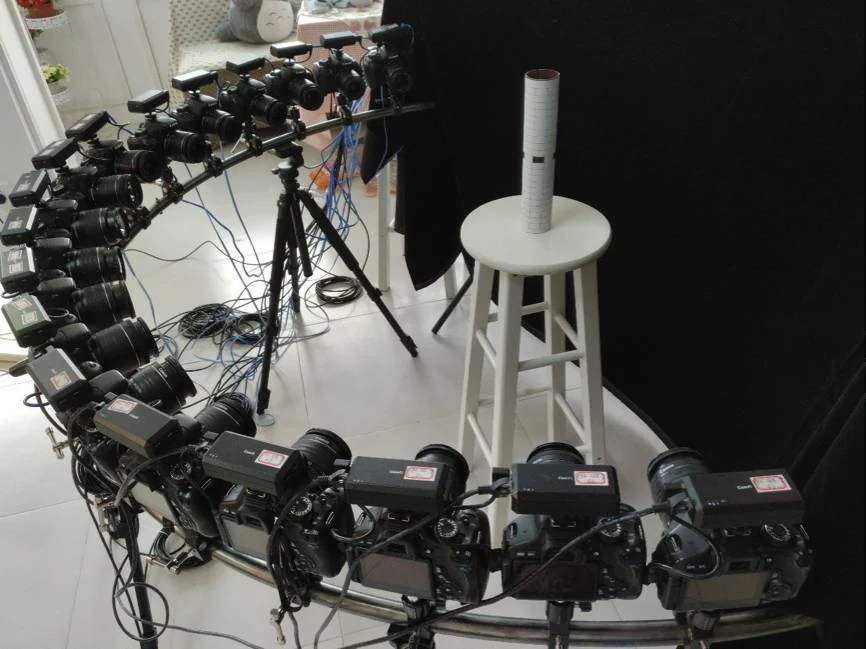
The Wachowskis' The Matrix (1999) built its bullet-time sequences from a rig of still cameras arrayed around frozen action, interpolated into an apparent camera move through a moment no single camera ever traveled through. American Cinematographer's April 1999 account quotes director Lana Wachowski explaining the production wanted to shoot in extreme slow motion while keeping the apparent camera speed normal, calling it basically impossible by conventional means, and crediting visual-effects supervisor John Gaeta with the process that solved it. The Academy's own Scientific and Technical Award citation, listed on the 2001 honorees page, credits George Borshukov, Kim Libreri and Dan Piponi for image-based rendering that allowed choreographed camera movement through a computer-graphic reconstructed set.
What the documents establish
Read together, the two documents describe connected but distinct work: a physical still-camera rig producing raw frames, which the 1999 ASC piece attributes to Gaeta's process, and a separate image-based rendering technique letting the effects team reconstruct the set in computer graphics and choreograph a camera path through it, which the Academy credits to a different, named trio. The ASC piece defers full technical detail to a companion visual-effects article in the same print issue, so this entry treats it as a production account of intent and authorship, and relies on the Academy citation for the rendering method's own description.
The department view
This was a visual-effects department build, distinct from principal photography: the still-camera array and its choreography had to be planned and rigged before the actors performed, since the camera move existed only afterward, in software. That is the department trade-off a modern virtual-camera operator still manages, planning a shot's data capture before the interactive part exists, rather than reacting to a viewfinder in real time as a physical camera operator does.
What to check before you build
This is an editorial checklist. A claim that bullet time is the same as today's virtual-camera or previsualization tools should be checked against what the Academy citation names, image-based rendering of a reconstructed set, a method distinct from a live real-time render engine used on a current volume.
- Does a source credit the camera rig, the rendering technique, or both, and are the named contributors for each kept separate?
- Is virtual camera being used here to mean a live, real-time system, or a post-production reconstruction, as the Academy citation describes?
- What does the source say was planned before the shoot versus solved afterward in software?
Bullet time's documented lineage runs through image-based reconstruction of a captured scene, not a real-time render, which is the distinction to preserve before calling it an ancestor of a live virtual-camera system.
Sources & reading trail
Contemporaneous American Cinematographer account quoting Lana Wachowski on the production's goals and crediting John Gaeta with the bullet-time process.
Source published: 1 April 1999 · Retrieved: 16 September 2026
Academy citation crediting Borshukov, Libreri and Piponi for the image-based rendering technique behind The Matrix's virtual camera moves.
Source published: Not established · Retrieved: 16 September 2026
Vendor documentation, standards and reports establish the entry; the department view is Stagecraft Atlas editorial analysis. This retrospective draft does not imply the site published on the event date.