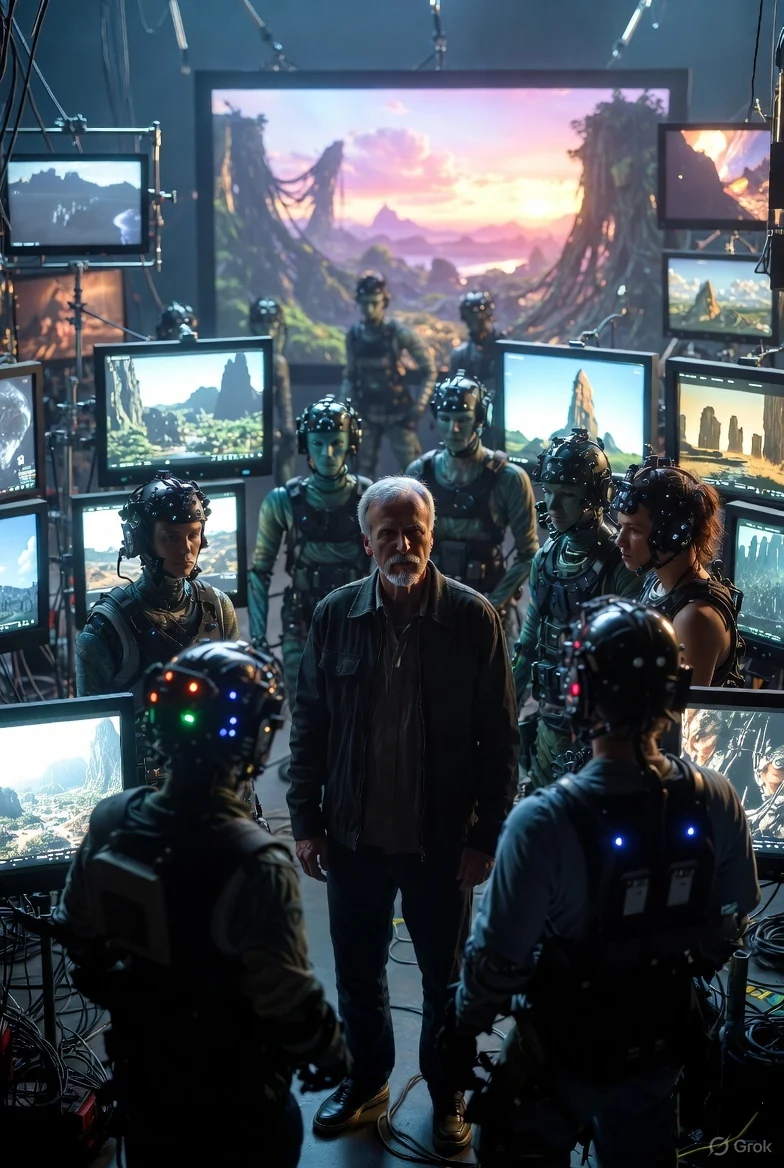
The stage
James Cameron's Avatar (2009) used a system called Simulcam to composite a low-resolution computer-graphics environment with live performance-capture data during principal photography. American Cinematographer's January 2010 account quotes virtual-production supervisor Glenn Derry describing a live-action camera fitted with tracked position reflectors, generating a matching virtual camera inside the CG environment, so the two images were composited together live and sent to monitors on set, letting Cameron follow a background element before settling on an actor in frame, in real time. A later ASC retrospective, published in August 2023, instead credits cinematographer Robert Legato, ASC with pioneering the underlying concept, describing him adapting motion-control technology to take live input from a motion-captured performer.
What the documents establish
Read side by side, the two ASC accounts do not simply repeat each other; they attribute Simulcam's origin differently, the contemporaneous 2010 piece naming Derry as the system's builder and virtual-production supervisor, the 2023 retrospective crediting Legato with proposing the underlying adaptation to Cameron. This entry treats both as documented trade accounts rather than resolving the attribution, since neither is the company's own engineering record and the two may describe different stages, concept and implementation, of the same system. What both agree on is the mechanism: real-time compositing of a tracked live camera with a CG environment, viewable on set rather than only in post-production.
The department view
Simulcam sat with a dedicated virtual-production department, separate from the camera department operating the physical rig and from the visual-effects vendor building final-resolution assets later. The 2010 account describes Cameron handholding a camera while virtually repositioned at a Na'vi character's nine-foot eye level, meaning the department's job was to keep a low-resolution stand-in world responsive enough for a director to block and frame a shot, a real-time requirement distinct from the offline rendering used for the finished frame.
What to check before you build
This is an editorial checklist. Before citing Simulcam as identical to a current LED-volume in-camera workflow, check the stated resolution and purpose: both sources describe a low-resolution, on-set previsualization aid for framing and performance, not a final-pixel composite, which is a different function from LED-wall in-camera visual effects.
- Which account is being cited for a Simulcam attribution claim, and does it match or conflict with the other?
- Does the source describe a low-resolution previsualization composite or a final-pixel in-camera composite?
- What specific department or role is credited with building versus operating the system?
Simulcam's documented value was letting a director frame and perform inside an unfinished world in real time, a distinct problem from final-pixel compositing that a modern brain bar still separates into two different tools.
Sources & reading trail
Contemporaneous American Cinematographer account naming Glenn Derry as Avatar's virtual-production supervisor and describing Simulcam's real-time compositing.
Source published: 1 January 2010 · Retrieved: 16 September 2026
Later ASC retrospective crediting Robert Legato, ASC with pioneering the Simulcam concept, a different attribution than the 2010 account.
Source published: 19 August 2023 · Retrieved: 16 September 2026
Vendor documentation, standards and reports establish the entry; the department view is Stagecraft Atlas editorial analysis. This retrospective draft does not imply the site published on the event date.