The stage
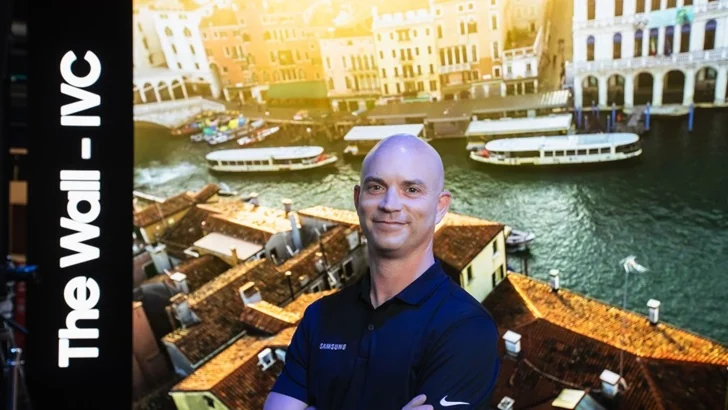
Samsung sells a MicroLED product line called The Wall for Virtual Production, marketed separately from its consumer displays and from Onyx, the company's cinema screen. The vendor's virtual-production page, retrieved 16 September 2026, lists several pixel-pitch tiers under this line: P0.8, P1.2 and P1.6 modules built for close-camera work, with peak brightness between 1,400 and 1,600 nits and refresh rates listed at 11,520Hz to 15,360Hz depending on model, alongside coarser P2.5 modules aimed at wider volume or ceiling coverage. The page also names two configuration types, an oval 'Volume Studio' and a cornered or curved 'XR Studio', as layout options rather than fixed products.
What the documents establish
A separate, dated Samsung newsroom piece, an interview published 9 November 2023, quotes three named Samsung engineers describing design choices behind the same product: a 4:9 module ratio meant to reduce visible seams, genlock plus a phase-offset control to align the screen's refresh with a camera shutter, and a refresh rate of 12,288Hz that does not match any single figure on the current spec page. That gap likely reflects a spec page revised since 2023, but it means the two documents should not be treated as one static number; each is dated to when Samsung recorded it. The interview also names CJ ENM's Paju stage, installed by Samsung's own account 'last May' relative to the November 2023 piece, as the reference installation, though neither document publishes an independent measurement of that stage's on-camera performance.
The department view
These figures matter most to the DIT and the LED-processing operator, who translate a rated refresh rate and genlock behaviour into a workable match with the camera's shutter angle, and to the brain bar, which maps content resolution against whichever pitch tier is installed. A pitch chosen for a wide establishing shot is not the pitch a production needs for a close insert, and Samsung's own tiering reflects that trade-off with four brightness and pitch combinations rather than one.
What to check before you build
This is an editorial checklist, not Samsung's own guidance. Before booking a volume built around this product, ask the integrator which specific module, P0.8 through P2.5, is actually installed, since the page's brightest headline figures apply to the finest-pitch, most expensive tier. Also ask which software revision's genlock and phase-offset behaviour is in use, since that detail comes from the 2023 interview rather than the current spec sheet.
- Which Wall module, by pixel pitch, is specified for this stage, and does the quoted refresh rate match that model or a different one in the line?
- What genlock and phase-offset configuration is documented for this installation, and who verified it against the camera in use?
- What evidence beyond the vendor's own materials exists for how this screen performs at the production's actual camera distance?
Samsung's own materials agree on the broad shape of the product line but not on every figure, and that gap is itself the useful finding: a spec page and a dated interview are different kinds of vendor statement, and neither substitutes for a camera test on the specific panel a stage installs.
Sources & reading trail
Samsung's own spec tables for The Wall's pixel-pitch tiers, nit ratings and refresh rates, and its Volume/XR studio configurations, as retrieved.
Source published: Not established · Retrieved: 16 September 2026
Named Samsung engineers describe refresh-rate, genlock and phase-offset engineering choices and reference the CJ ENM Paju installation.
Source published: 9 November 2023 · Retrieved: 16 September 2026
Vendor documentation, standards and reports establish the entry; the department view is Stagecraft Atlas editorial analysis. This retrospective draft does not imply the site published on the event date.