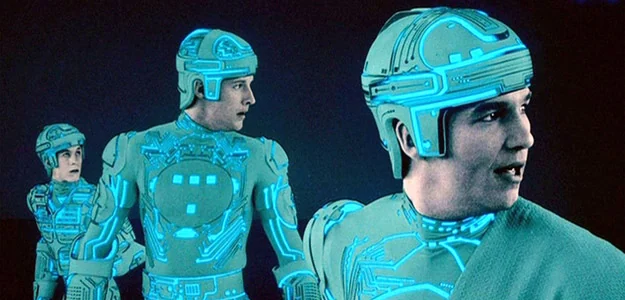
The stage
Walt Disney's Tron reached theaters in 1982 combining, per American Cinematographer's August 1982 account, true computer-generated imagery from two outside firms, Mathematical Applications Group Inc. and Information International Inc., with extensive backlit rotoscope animation produced by hand. The light-cycle chase, Sark's command carrier and the solar sailer were computer generated; the light cycles rezzing up around their live-action riders, and most shots combining actors with the electronic world, were conventional animation, because, in the article's own words, there was then no practical means of compositing live action with computer imagery beyond a simple background.
What the documents establish
The ASC account is a contemporaneous, technique-by-technique breakdown that runs against the casual shorthand of Tron as the first CGI movie: most of what audiences perceived as a computer-generated character interacting with a computer-generated world was backlit animation, requiring, by the article's own account, more than 200 workers in Taiwan inking cels for four months. The Academy's own nominee record for the ceremony honoring 1982 films lists Visual Effects nominees as E.T. the Extra-Terrestrial, the winner, Blade Runner and Poltergeist; Tron received no nomination in that category. That is a documented Academy record, not an explanation of the branch's reasoning, and this entry does not attribute a motive to voters beyond the nominee list itself.
The department view
Two departments carried the film's look: an outside computer-graphics vendor generating wireframe and shaded imagery on scarce mainframe time, and an in-house animation and optical department handling backlighting, cel work and compositing at a scale closer to a traditional animated feature. The labor split the article records, hundreds of hand inkers against a small computer-graphics crew, is a department-workload fact worth checking before repeating the first-CGI-film claim, since it shows which department did the majority of the frame-by-frame work.
What to check before you build
This is an editorial checklist. Before citing Tron in a virtual-production context, check whether a specific sequence was CGI or backlit animation according to the ASC account, since the two are frequently conflated in casual retellings; also check whether an awards claim rests on a documented nomination or its absence.
- Does a cited account specify which sequence used CGI versus animation, or generalize about computer effects?
- Is an award claim based on a documented nomination, or inferred from a film's reputation?
- What labor or department scale does the source give for the technique cited as a precedent?
Tron's documented history is a caution against tidy origin stories: the film that popularized the idea of a computer-generated world was, by its own studio's account, made mostly by hand.
Sources & reading trail
Contemporaneous American Cinematographer breakdown of which Tron sequences used CGI (MAGI, Triple-I) versus backlit rotoscope animation.
Source published: 1 August 1982 · Retrieved: 16 September 2026
Academy's own nominee record for the ceremony honoring 1982 films, confirming Tron received no Visual Effects nomination.
Source published: Not established · Retrieved: 16 September 2026
Vendor documentation, standards and reports establish the entry; the department view is Stagecraft Atlas editorial analysis. This retrospective draft does not imply the site published on the event date.