The stage
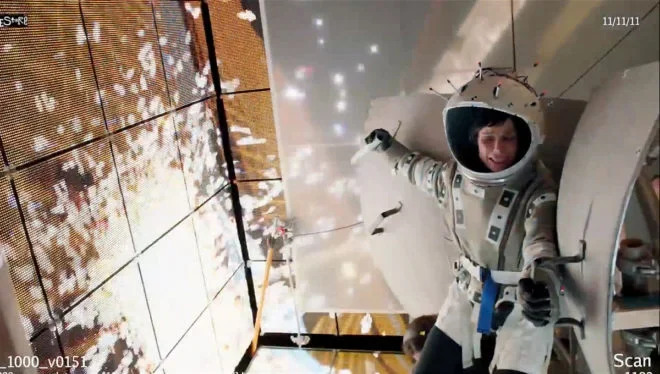
Framestore's own case-study page for “Gravity” (2013) describes a lighting rig built for one problem: showing Sandra Bullock's face lit by shifting, directionless light inside a tumbling spacecraft, without moving her through a real set. It states the rig was a 20-by-10-foot structure of 196 LED panels, 4,096 bulbs each, nicknamed “Sandy's cage.” Bullock stayed stationary while a camera on Bot & Dolly robotic arms moved around her to match a planned exterior shot. VFX supervisor Rich McBride recalls having “never seen a set-up like this.” The rig lit the actor; it did not display a background plate, unlike a modern in-camera LED wall.
What the documents establish
Framestore's page is the facility's own account of its build, so its figures are a vendor's description of its own work, not an independent measurement. The Academy's own record of the 86th Academy Awards confirms Gravity won the competitive Visual Effects Oscar, crediting Tim Webber, Chris Lawrence, David Shirk and Neil Corbould. That differs from the Academy's Scientific and Technical Awards, which certify a specific invention: its own 86th Scientific and Technical Awards list, covering the year after Gravity's release, names no award for Framestore, Gravity, or the light box. The visual-effects win honors the finished sequence, not a certified technical achievement for the rig.
The department view
The rig reorganized two departments. For the gaffer and DP, lighting became programming an LED wall to output a moving source already planned in previs, not aiming fixtures at a set. For visual effects, the box put a version of the finished environment's lighting on set during the shoot rather than fixing mismatches afterward. The trade-off is control against flexibility: because the rig lit the actor rather than showing a background the camera could record, the crew still needed a separate digital environment for anything behind her, presumably why building the ISS interior took a year.
What to check before you build
A producer weighing a similar rig against a modern LED volume should first check whether the goal is interactive lighting on a subject or an in-camera background a lens can resolve; Gravity's rig only did the former. This editorial distinction is not one Framestore states outright, but follows from its own description. Confirm any panel or bulb count against the vendor's material before repeating it as fact, since no independent measurement is cited here.
- Is the LED surface meant to be recorded by the camera, or only to light a subject recorded against something else?
- Which named people and companies does the primary account credit, and does a second document corroborate the same names?
- Is an award called a Scientific and Technical Award actually that award, or a different Academy category?
Gravity's light box is a real precedent for interactive, camera-adjacent LED lighting, and Framestore's account is specific about what it did. It is not evidence of an early background-wall volume, and the sourcing here does not support crediting it with a Scientific and Technical Award.
Sources & reading trail
Framestore's own account of the light box's dimensions, panel and bulb count, robotic camera arms, and the people credited with building it.
Source published: Not established · Retrieved: 16 September 2026
The Academy's own record that Gravity won the competitive Visual Effects Oscar, naming Tim Webber, Chris Lawrence, David Shirk and Neil Corbould.
Source published: Not established · Retrieved: 16 September 2026
The Academy's own list of Scientific and Technical Award recipients for the year following Gravity's release, which does not include Framestore, Gravity, or the light box.
Source published: Not established · Retrieved: 16 September 2026
Vendor documentation, standards and reports establish the entry; the department view is Stagecraft Atlas editorial analysis. This retrospective draft does not imply the site published on the event date.