The stage
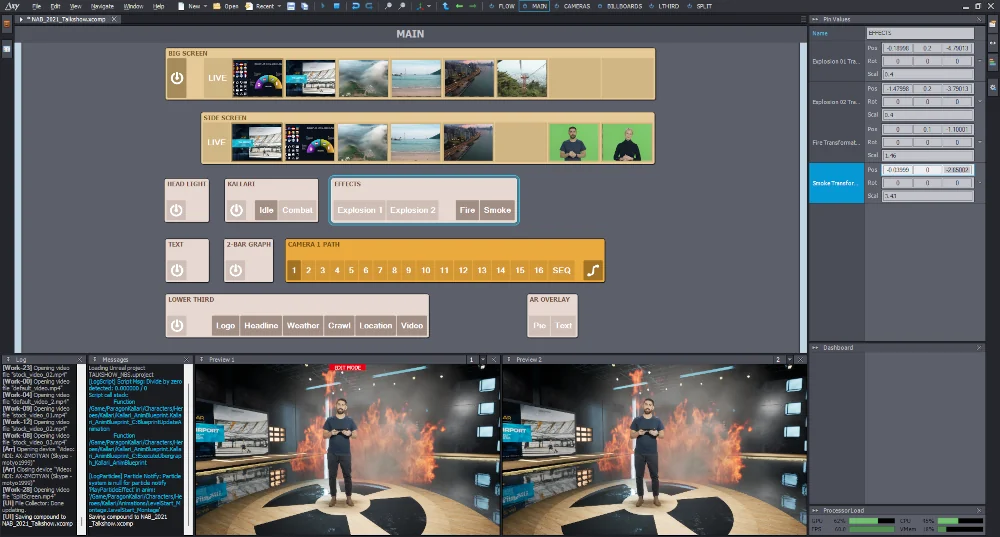
Aximmetry describes itself, on its own homepage retrieved on 16 September 2026, as a virtual-studio and real-time compositing platform aimed at “broadcast production, virtual event, pre-visualisation, LED wall based virtual production,” naming users from broadcast companies down to corporate video creators and individual streamers. The company's products page lists three named editions with published pricing: Studio Limited, a free tier with a single NDI output port; Studio, a mid-tier subscription with eight I/O ports; and Broadcast & Film, the professional tier with unlimited SDI and NDI ports and features such as XR production and multi-machine synchronization. Both pages describe a currently maintained product line rather than a dated release.
What the documents establish
The vendor's own pages establish that Aximmetry runs a dual-engine architecture: its own built-in real-time renderer alongside support for Unreal Engine 5, letting a production choose which engine handles a project rather than requiring Unreal for every case. The homepage states the platform bundles chroma keying, 3D graphics and virtual-studio tools as “all-in-one,” without separate module purchases, a packaging claim describing Aximmetry's own pricing structure, not an independently verified comparison against a named competitor. The publicly listed per-tier pricing, including a working free tier, is notable only because some broadcast and film virtual-production platforms gate pricing behind a sales conversation instead; this entry treats that as an editorial observation, not a claim about what any competitor charges.
The department view
The free and Studio tiers speak most directly to a previs artist or independent streamer setting up chroma-key and tracking on limited hardware, while the Broadcast & Film tier's unlimited I/O and multi-machine synchronization aim at a technical director running a full LED-wall stage. Aximmetry's camera-tracking language, an “open system to integrate any studio camera tracking device,” puts integration work on whichever crew member owns tracking hardware, since Aximmetry documents itself as tracking-device-agnostic rather than bundling a system. The trade-off across tiers is straightforward: lower editions trade port count for cost, while Broadcast & Film trades a higher price for the I/O headroom a professional stage needs.
What to check before you build
This is an editorial checklist, not a claim from Aximmetry. Confirm which edition, Studio Limited, Studio or Broadcast & Film, actually supports the port count a build requires, since the free and mid tiers are limited on I/O. Confirm whether a project needs Aximmetry's built-in renderer or Unreal Engine 5 for the asset pipeline required, since the dual-engine option carries different performance implications. Confirm the Maintenance+ terms for updates beyond the initial period before budgeting a lifetime license as a one-time cost.
- Does the edition being considered actually support the I/O port count and features this build requires?
- Should this project use Aximmetry's own render engine or its Unreal Engine 5 option, and what does that choice change?
- What do the Maintenance+ terms require to keep receiving updates after the initial license period?
Aximmetry's own materials describe a tiered, publicly priced platform scaling from a free single-port setup to a broadcast-and-film edition built for LED-wall synchronization, with the render-engine choice and maintenance terms the details most likely assumed rather than checked.
Sources & reading trail
Aximmetry's own homepage describing its target users and dual-engine, tracking-agnostic workflow.
Source published: Not established · Retrieved: 16 September 2026
Aximmetry's own products page listing its three named editions, published pricing and per-tier port limits.
Source published: Not established · Retrieved: 16 September 2026
Vendor documentation, standards and reports establish the entry; the department view is Stagecraft Atlas editorial analysis. This retrospective draft does not imply the site published on the event date.