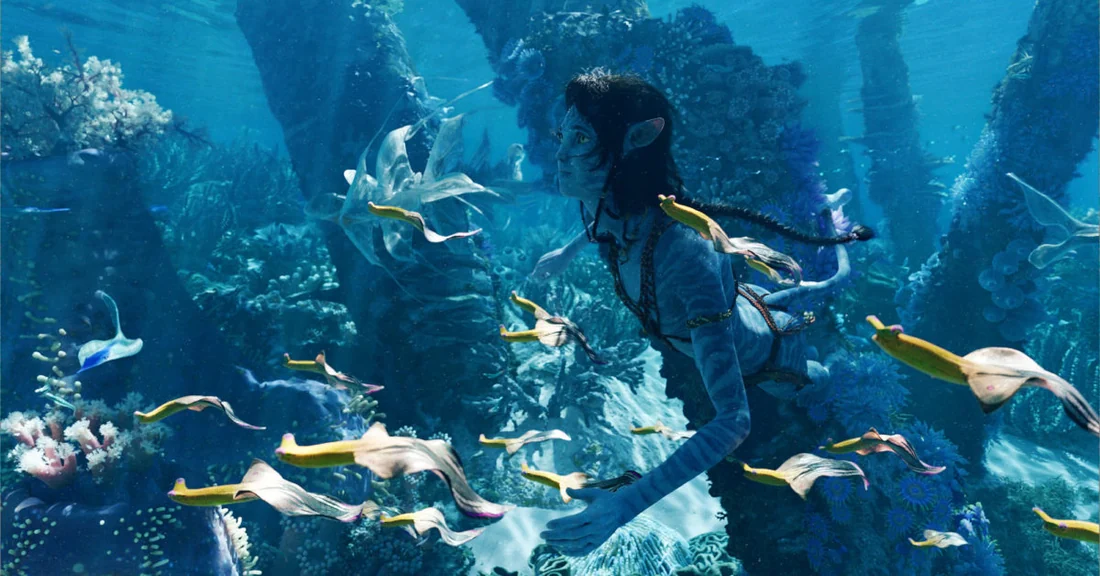
The stage
“Avatar: The Way of Water” reached theaters in December 2022 carrying a problem the franchise had not solved before: capturing a full-body performance while submerged, in sync with a capture volume above the waterline. In an interview published by Befores & Afters, Wētā FX senior visual effects supervisor Joe Letteri and Lightstorm's Richard Baneham describe dual capture volumes, one submerged in a tank and one above it, recording performers as they moved between water and air. A second interview, from the same outlet the following spring, has special effects supervisor JD Schwalm of Innovation Workshop describing the physical wave tank: a 120-by-60-by-30-foot facility at Manhattan Beach Studios holding over 250,000 gallons, built for physically accurate waves and currents.
What the documents establish
Both pieces are crew interviews from an outlet specializing in named, direct conversations with visual-effects staff, a different kind of source than a vendor's marketing page. The detail both converge on is light: standard infrared motion-capture markers fail underwater because water absorbs red wavelengths within feet. Lightstorm's Giant team, per Ryan Champney as quoted, solved this with light “super blue, almost ultraviolet,” distinct from the infrared used above the surface, so both systems could run at once without interference. Neither piece states an exact frame rate, marker count, or camera model, so those specifics should not be assumed.
The department view
The change reaches animation. Senior animation supervisor Dan Barrett describes actors who, once comfortable holding their breath, gave the team performances animators built digital movement from directly, rather than inventing underwater motion from a dry-stage take. The production accepted a purpose-built dual-volume stage and, per Letteri, a year and a half of development, for reference the crew judged more authentic than simulated buoyancy. The wave-tank interview adds a second department's stake: hydraulic wave-making equipment built to physically accurate specifications so the same water dynamics could inform the digital water compositors layered in afterward.
What to check before you build
Anyone citing this precedent should check whether a detail describes the dry volume, the wet volume, or the physical tank, since the two interviews cover different halves of one production. This is an editorial note: neither source gives exact marker specifications or camera hardware, so a production estimating underwater-capture costs should treat the tank dimensions and light-color detail as documented, and treat the rest as inference.
- Does a cited detail come from the underwater volume, the above-water volume, or the physical wave tank, and are those kept distinct?
- What wavelength of light is a proposed tracking system using, and has it been tested against the intended tank's water clarity and depth?
- How long did the crew reportedly spend on system development before photography, and does that match the production's own schedule?
The documented lesson is narrow but concrete: infrared tracking fails underwater, and Lightstorm's team addressed that with a wavelength swap, not a different marker or tracking principle, a specific engineering choice rather than a general claim that underwater capture is solved.
Sources & reading trail
Named Weta FX and Lightstorm crew describe the dual above/below-water capture volumes and the near-ultraviolet lighting solution for underwater tracking.
Source published: 21 December 2022 · Retrieved: 16 September 2026
Innovation Workshop's special effects supervisor describes the physical wave-tank dimensions, capacity, and wave-making hardware built for the production.
Source published: 2 April 2023 · Retrieved: 16 September 2026
Vendor documentation, standards and reports establish the entry; the department view is Stagecraft Atlas editorial analysis. This retrospective draft does not imply the site published on the event date.