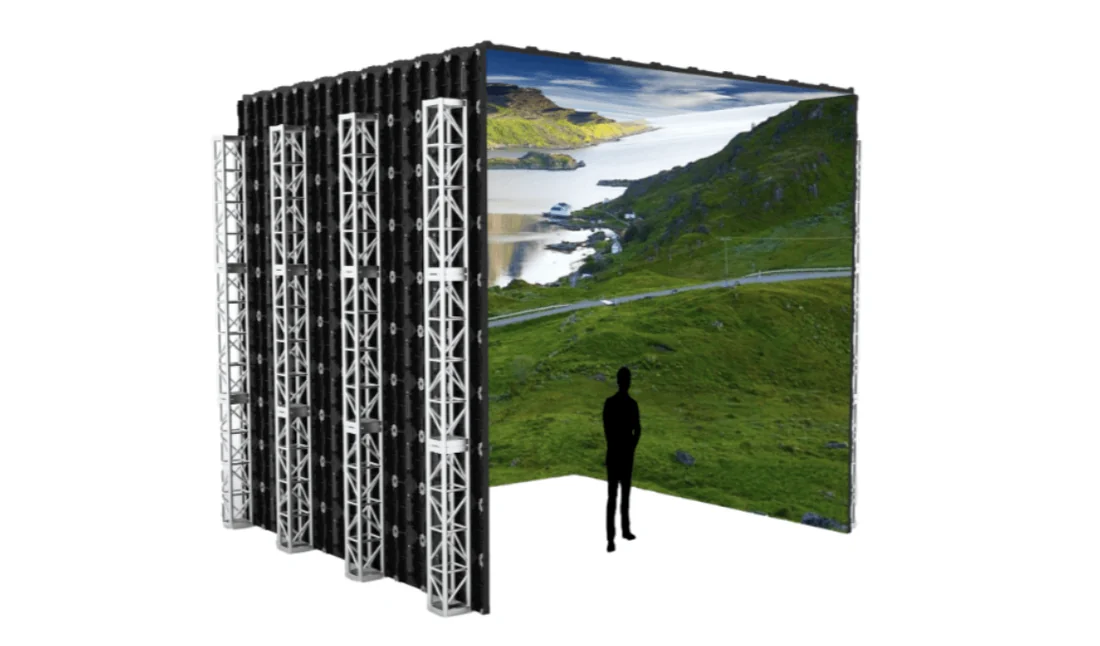
The stage
Vū Technologies, retrieved 16 September 2026, lists 29 named cities on its own locations page: eighteen across the United States and Canada, from Austin to Toronto, and eleven more spanning Amsterdam, Seoul, Tokyo and other cities. The page describes the network broadly as offering "state-of-the-art virtual production facilities" without publishing a stage count, LED specification, or opening date for any individual site. Vū's homepage positions the company primarily as a technology and financing provider rather than a studio operator: it offers "one platform and endless possibilities for production and engagement" through its Vū Studio software and Vū One hardware, alongside a client testimonial crediting Vū with helping "finance the studio purchase" behind one listed location.
What the documents establish
Read together, the two pages establish a distribution model rather than a single measured facility: Vū's own materials describe a network partners can join with Vū's financing and software, not a chain of identically specified stages Vū itself built and owns outright. That distinguishes Vū's claim from a single-flagship operator, whose own pages describe one named, physically specific volume. Vū's homepage does not publish a total stage count, a total square footage, or a uniform LED specification across its 29 listed cities, so a reader cannot infer that every location offers the same capability from these pages alone.
The department view
The financing detail changes who a location's operator answers to on a production day: at a Vū Network site, the physical operator may be a local partner rather than Vū's own crew, which matters to a production manager confirming who holds insurance, staffing, and stage-day responsibility. A brain-bar operator or DIT booking a Vū location in one city should not assume the exact processing stack matches another city's setup, since the network model, by Vū's own description, spreads ownership rather than standardizing a single build.
What to check before you build
This is an editorial checklist. A production should confirm the specific stage specifications, wall dimensions and processing hardware, at the exact Vū-network location it plans to book, rather than assuming uniformity across the 29 listed cities. A production should also ask whether the local site is Vū-operated or a financed partner, since staffing and support may differ. Finally, a reader should treat the 29-city count as accurate only as of 16 September 2026, since a network of this kind can add or drop cities between visits.
- Is the specific Vū-network location Vū-operated, or a financed local partner, and what does that mean for on-site support?
- What LED, tracking and processing specification applies at that one location, rather than the network generally?
- Has the 29-city count been rechecked against Vū's current page rather than an older reference?
Vū's pitch, documented in its own materials, is scale through a distributed partner network rather than one flagship volume. That is a genuine alternative business model to a single-stage approach, but it also means a production must verify each location's specific build rather than trusting the network's size as a proxy for any one stage's capability.
Sources & reading trail
Vū's own locations page lists 29 named cities (18 in North America, 11 international) as of the retrieval date, without per-location specifications.
Source published: Not established · Retrieved: 16 September 2026
Vū's own homepage frames its offering as software and hardware plus a partner 'Vū Network,' including a client testimonial describing Vū financing a studio purchase.
Source published: Not established · Retrieved: 16 September 2026
Vendor documentation, standards and reports establish the entry; the department view is Stagecraft Atlas editorial analysis. This retrospective draft does not imply the site published on the event date.