The stage
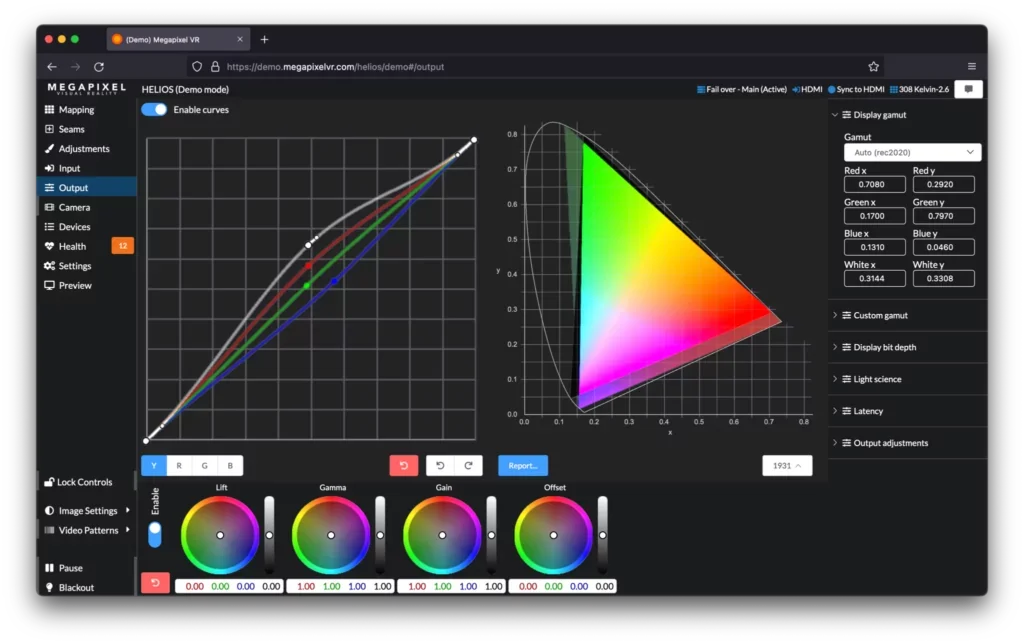
Megapixel VR's own Helios product page, retrieved 16 September 2026, describes an LED processing platform built for camera-facing virtual production walls. It states Helios delivers “100% Color Accuracy and pixel-perfect detail,” a grayscale feature branded LightScience, and “dynamic, real-time color gamut adjustment,” alongside NanoSync for “clean camera capture of LED displays.” On hardware, the page lists an 8K video pipeline, “32K panoramic potential,” eight 10G fiber outputs, and a single rack-unit form factor, plus a Camera+ mode embedding cue markers for performers, hidden camera-tracking markers, and hidden chroma-key frames within the same processor.
What the documents establish
Every specification here is Megapixel's own description of its own hardware; “100% Color Accuracy” is a vendor marketing claim, not a measurable, independently verified result, and should be read that way rather than repeated as fact about color science. A separate Megapixel page hosting the company's SMPTE ST 2110 Virtual Production Cookbook corroborates the general framing that virtual production means “capturing GPU-rendered visual effects composited with live action in-camera within an LED volume,” a definitional statement, not a Helios-specific spec, and it does not confirm any of the Helios page's numeric claims. No customer production's results appear on either page, so none should be repeated here as a benchmark.
The department view
For the tracking and brain-bar crew, Camera+'s hidden markers and cue points are the concrete workflow feature: one processor handling visible content plus hidden tracking or chroma data means fewer separate systems to genlock, at the cost of depending on one vendor's box for more of the pipeline. For the DP and colorist, the claimed real-time gamut adjustment matters because, per the page's framing, panels in a volume function as light source and background at once, so camera color decisions also change how the wall lights the actor in front of it, a dual role a broadcast display does not have.
What to check before you build
This is an editorial checklist: treat every accuracy and color-management claim on Megapixel's page as a vendor statement to verify with a camera test on the specific panel and lens combination planned, not as a settled spec. Confirm the “32K panoramic potential” and multi-feed figures against the exact tile configuration a build will use, since the page ties feed count to configuration rather than presenting it as fixed.
- Has “100% Color Accuracy” or any similarly absolute vendor claim been tested against the specific camera, lens, and panel combination planned?
- Does the planned tile configuration support the number of simultaneous video feeds needed, given that feed count ties to configuration?
- Are hidden-marker and chroma-key features being relied on for a specific department's workflow, and has that department confirmed compatibility?
Megapixel's own page is specific about what Helios is designed to do inside a volume, but its most absolute claims are vendor marketing language a production should confirm on its own stage before relying on them.
Sources & reading trail
Megapixel's own listing of Helios's color-management claims, hardware specs, and the Camera+ mode's hidden-marker and chroma-key features.
Source published: Not established · Retrieved: 16 September 2026
Megapixel's own definitional framing of virtual production as GPU-rendered visual effects composited with live action in-camera within an LED volume.
Source published: Not established · Retrieved: 16 September 2026
Vendor documentation, standards and reports establish the entry; the department view is Stagecraft Atlas editorial analysis. This retrospective draft does not imply the site published on the event date.